We manufacture metal and engineering-plastic parts on numerically controlled machine tools, using either our own or customer-supplied material. We handle projects from prototypes to repeat production runs.

We have provided CNC machining services since 2008. An order begins with a technical drawing: we prepare the machining program, select tools and a clamping method, make the part, and check its dimensions before dispatch. We work for manufacturers of machinery, automation, hydraulics, electronics and paper-industry equipment.
Four technologies are available under one roof, so a part does not move between subcontractors. The same facility turns, mills, cuts and bends, while the inspection documentation remains in one place. We describe the scope and capabilities of each technology on separate pages.
We fulfil orders using our own material and customer-supplied material. A 3.1 mill certificate to EN 10204 is obtained on request. We do not sell the raw material itself; we make parts from it. The processes are covered by an ISO 9001:2015 quality management system.
Machining, also called chip-forming machining, removes excess material as chips until the part reaches the dimensions and shape shown on the drawing. CNC stands for Computer Numerical Control. Tool movement is controlled by a program rather than by the operator’s hand.
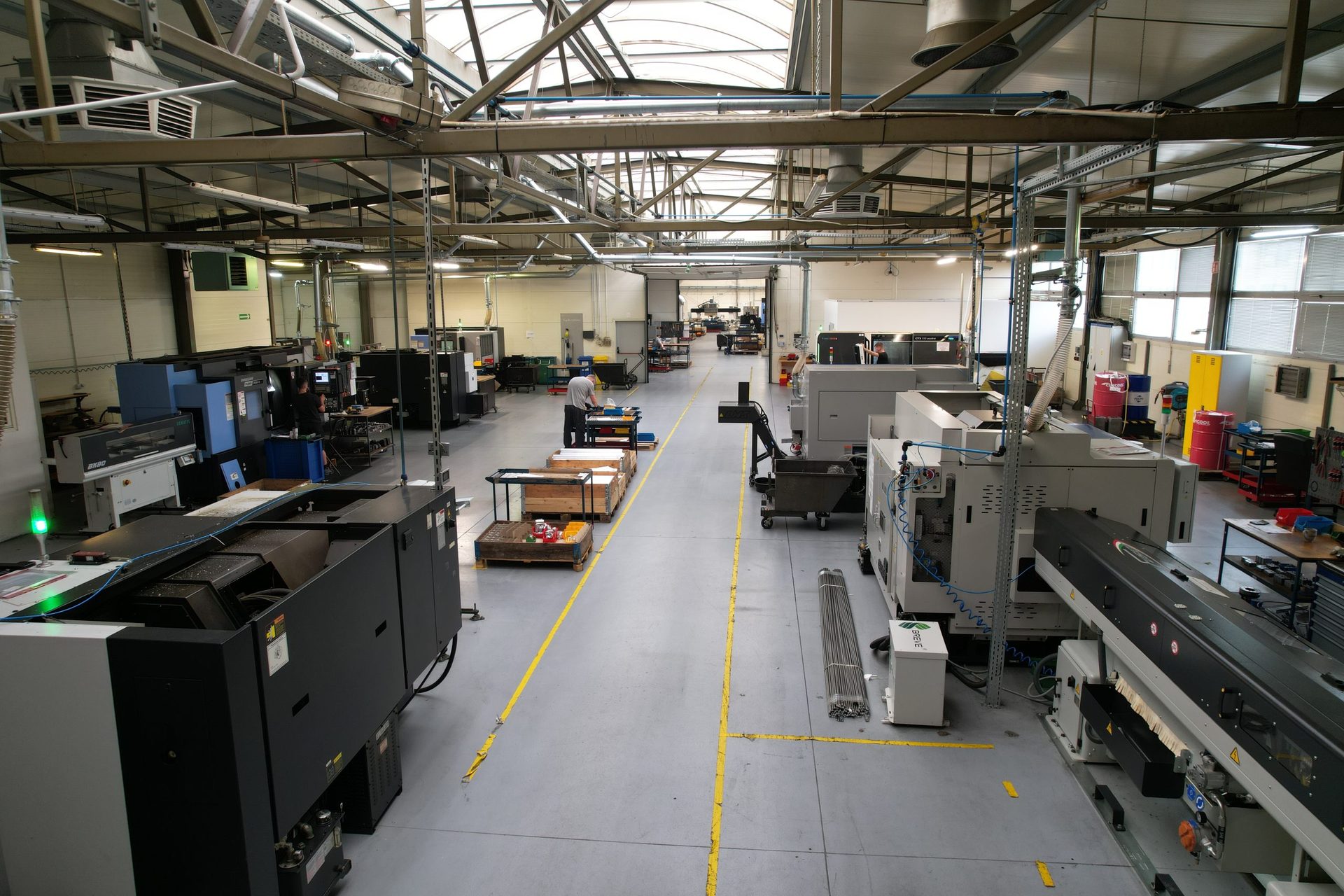
A full list of machine tools and their working ranges is available on the machine park.
The same principle, different parameters. The material grade determines cutting speed, cooling and how the part behaves after removal from the machine.
Tools and cutting parameters are set separately for each grade. We have compiled the full list of materials on the materials.
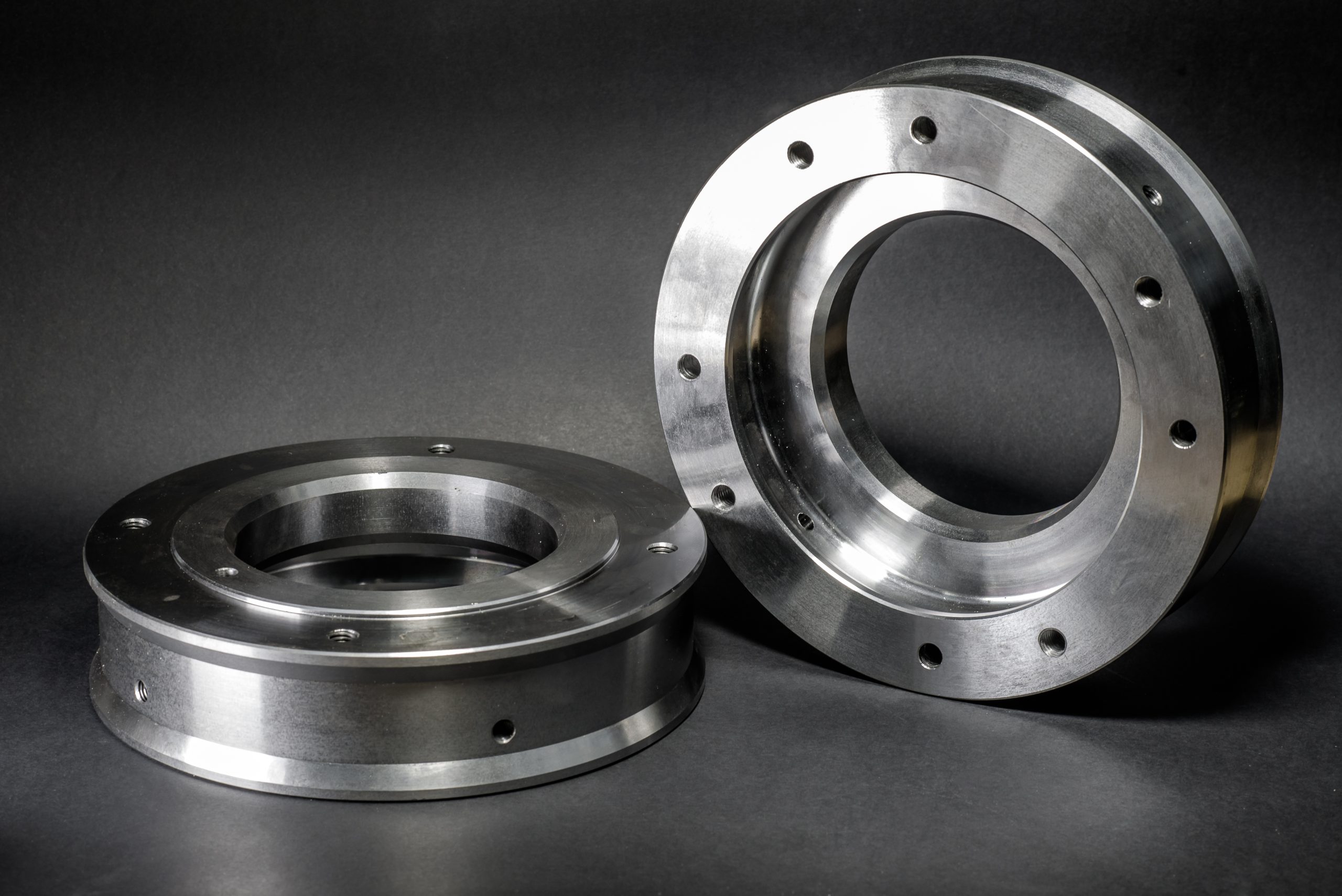
CNC turning covers rotational parts: shafts, bushes, flanges and seats. The material rotates while the tool follows the contour. This technology is selected whenever a part has an axis of symmetry. The CNC turningpage describes diameter ranges, turning lengths and automatic-lathe operation.
CNC milling covers non-rotational parts: housings, plates, blocks and components with complex geometry. The tool rotates and the workpiece remains clamped. The fifth axis reduces the number of clampings, so a complex part can be made in one setup. Working envelopes are given on the CNC millingpage.
CNC cutting on cutting-and-milling plotters covers sheets and soft materials: plastics, rubber, silicone, Viton and thermal-insulation materials. An oscillating knife does not heat the material, leaving a clean edge. The working areas of the plotters are given on the CNC cuttingpage.
CNC bending on a press brake forms sheet metal without removing material, with springback compensation. A part can go through cutting, machining and bending within one order. Press-brake parameters are given on the CNC bendingpage.
The indicative hourly machine rate is 140-250 PLN/h for CNC milling and CNC turning.
| Service | Indicative rate |
|---|---|
| CNC milling | 140-250 PLN/h |
| CNC turning | 140-250 PLN/h |
These are indicative ranges, not a price list for individual parts. The cost of a specific part depends on several factors at once: material grade, batch size, drawing tolerance, number of clampings and whether the part needs additional processes. The same part made in aluminium and stainless steel requires two different machine times.
For batches, the cost per piece decreases because programming and tooling preparation are spread across all parts. For a single piece, the same effort is charged to one part, so a prototype can cost more than intuition suggests.
We quote from a drawing, not from a verbal description. After receiving a file, we respond with a price, proposed technology and lead time.
Send a drawingFor precision turning and 5-axis milling, we work to tolerances down to 0.01 mm. We discuss tighter requirements before accepting an order.
We check dimensions in our own measurement laboratory equipped with TESA and MITUTOYO instruments and an ABERLINK Axiom coordinate measuring machine.
View quality control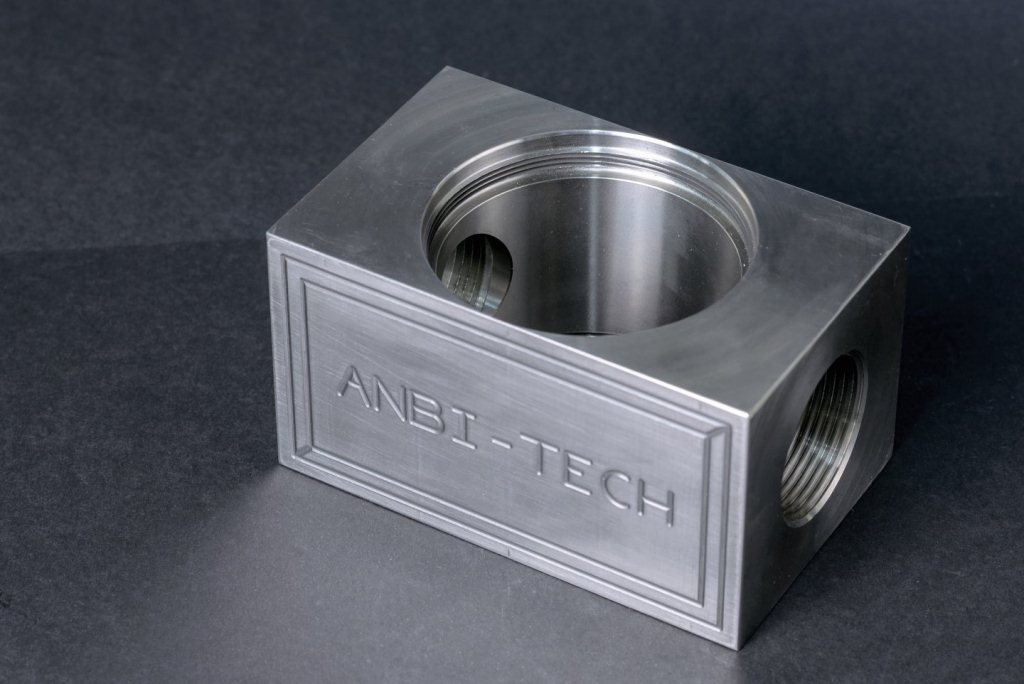
The quality management system covers PN-EN ISO 9001:2015, PN-EN ISO 14001:2015 for the environment and PN-EN ISO 45001:2024 for occupational safety. We maintain 98 percent on-time delivery.
For the automotive industry, we prepare PPAP documentation. A 3.1 mill certificate to EN 10204 is standard for metals and is issued by the material supplier. The system and metrology equipment are described in the quality policy.
We carry out laser marking, vibratory finishing and PEM-insert assembly in-house. We coordinate passivation, polishing, anodising, electroplating and powder coating with partners, so the customer receives a finished component. The scope is described on the special servicespage.
Send a drawing in DXF, STEP, IGES, SLDPRT or PDF format. We will respond with a price, proposed technology and completion date.
We make metal and engineering-plastic parts: housings and blocks, machine-structure components, sealing, centring and bearing bushes, valve seats and nozzles, as well as sliding plates and strips. For the paper industry, we manufacture covers, dewatering and pressure strips, and cover clamps.
We accept orders from prototypes leading to production through to repeat batches, using our own or customer-supplied material. We handle larger production projects through CNC subcontracting.
ANBI-TECH Sp. z o.o., Olewin 50A, 32-300 Olkusz. Telephone +48 32 788 70 10. Email: anbi@anbi-tech.pl.
Repeatability in machining does not come from the machine alone. It depends on three things: rigid and predictable workpiece clamping, stable cutting conditions, and measurement that detects deviation before it increases. The program records the toolpath, but the clamping method determines whether the next part will be the same as the first.
The second factor is heat. A workpiece heated during machining has different dimensions from the same workpiece after cooling, and the thermal expansion of aluminium is more than twice that of steel. With tight tolerances, measurement is therefore carried out after the temperature has stabilised, rather than immediately after removal from the fixture.
Orders can be placed in two ways. With our own material, we purchase the raw material and obtain a 3.1 mill certificate to EN 10204 on request. With customer-supplied material, the customer provides the raw material or semi-finished product and we carry out the machining. We do not sell the material itself; we make parts from it.
We can quote fastest when an order includes a complete drawing. Four pieces of information are useful: a model or drawing with dimensions and tolerances, the material grade or functional requirement, the quantity, and the required delivery date. If the part will operate in a particular environment, it is worth stating this, as material selection can be more important than geometry itself.
We manufacture in Olewin near Olkusz, in the Lesser Poland region between Krakow and Katowice. We accept enquiries from across Poland by email or through the contact form, and ship finished parts to the address provided.
CNC machining is the manufacture of parts on numerically controlled machine tools, where a computer program directs tool movement. The abbreviation stands for Computer Numerical Control. In machining, material is removed as chips until the part reaches the shape and dimensions shown on the drawing. The most common technologies include turning, milling and drilling.
The indicative hourly rate for CNC milling and CNC turning is 140-250 PLN/h. The cost of a finished part depends on material grade, batch size, tolerances, the number of clampings and additional processes. For larger batches, the price per piece falls because the work involved in programming and tooling is spread across the whole batch. We provide a specific price after receiving a drawing.
In turning, the material rotates and the tool follows the contour, producing rotational parts such as shafts, bushes and flanges. In milling, the tool rotates and the part is clamped, so housings, plates and components with complex geometry are made. Many parts use both technologies, for example a turned bush with milled seats.
Metals: aluminium EN AW-6082, 5083, 7075 and Mic6; steel S235, S355 and 42CrMo4; stainless steel 1.4404, or 316L; Cu-ETP copper, CuSn12 bronzes and grade 5 titanium. Engineering plastics: PEEK, PTFE, POM, PA-6, PC and PVDF. We also cut rubber, silicone, Viton and polyurethane. We have compiled the full list on the materialspage.
For precision turning and 5-axis milling, we work to tolerances down to 0.01 mm. Achievable accuracy also depends on material grade, part size and the number of clampings, so we confirm drawing requirements before accepting an order.
We accept DXF, STEP, IGES, SLDPRT and PDF files. We can quote fastest on documentation containing dimensions with tolerances, material grade, quantity and the required delivery date. If any of these is missing, we will ask for it before quoting.
We make samples and prototypes for companies with which we already work. For new projects, we undertake the prototype stage when the order is intended to lead to serial production. Typical development includes about 5 prototypes, an initial batch of 20-50 pieces, followed by batches of 100, 500 or 1000 pieces. This describes a cooperation model, not a fixed threshold.
Yes. We work with both our own material and material supplied by the customer. With our own material, we obtain a 3.1 mill certificate to EN 10204 on request. We do not sell the raw material or semi-finished products themselves; we make parts from them.
IT tolerance grades are part of the system of linear-dimension tolerances described in ISO 286-1. The system applies, among other things, to cylinders and pairs of parallel surfaces and is used to define permitted dimensional variation. On a technical drawing, a tolerance notation helps communicate manufacturing requirements unambiguously for a selected dimension.
We publish references we have received and reviews from the ANBI-TECH business profile on Google Maps. The English versions are faithful translations of the Polish originals.
I can wholeheartedly recommend Anbi-Tech as a reliable and professional partner in machining and in manufacturing parts for the pharmaceutical industry. This is the third company where I have had the pleasure of working with Anbi-Tech, and the cooperation has been of the highest standard every time.
The pharmaceutical industry is exceptionally demanding: precision, on-time delivery, material quality and a full understanding of the customer’s needs all matter. Anbi-Tech has repeatedly proved that it is very well suited to this environment. The company has manufactured change parts, spare parts, filling needles, conveyor screws, components for dispensing powders and liquids, and many other production components for us.
The quality of the parts deserves particular recognition, whether they are made from 316L and 304 stainless steel or plastics such as POM, polyurethane and polycarbonate. The components are manufactured to a very high standard, with close attention to accuracy and detail, which is crucial in our industry.
Anbi-Tech has literally ‘saved our skin’ on many occasions in emergencies where time, a rapid response and a flexible approach to the customer mattered. A major strength of the company is its modern machinery, which enables it to complete even highly demanding projects while maintaining the highest standard of workmanship.
The people are equally important: the company’s staff always show complete commitment and a willingness to cooperate and provide technical support. Their extensive experience, professionalism and collaborative approach to customers are clear to see.
In pharmaceuticals, the ‘paperwork’, meaning certificates, is also important. The certificates have never been questioned during customer or regulatory audits, for example by GIF.
I strongly recommend working with Anbi-Tech to any company looking for a proven, reliable and quality-focused technical partner.
Dariusz Stachowicz, Senior Maintenance Manager, Polfa Warszawa S.A.
We had a very good experience working with Anbi-Tech on a new production line project for a bottling plant. Using a bottle sample and components from the old line, its engineer prepared the design and documentation for new change parts in SolidWorks. Anbi-Tech then manufactured timing screws, star wheels, drive components, bottle orienters, bottle turners and feeding components, among other items.
A major advantage is the end-to-end approach, from analysis and design through to the manufacture of finished components. Their considerable technical experience, precision and ability to solve unusual problems are clear. I recommend them.
Bartłomiej Ć, Specialist, ORLEN
We work with Anbi-Tech to manufacture parts and technical components for our projects. We value them above all for their workmanship, on-time delivery and excellent communication. When requirements are unusual, they can advise us and find a solution instead of simply manufacturing a part from a drawing. A reliable partner that I am happy to recommend.
Marek P., Production Manager, Triccor
A reliable company with extensive experience! They manufacture parts from steel, aluminium and specialist plastics such as POM and PTFE. Every service, whether turning, milling or CNC cutting, is carried out perfectly and with attention to the smallest detail. Excellent communication, professional advice and consistently on-time delivery. I wholeheartedly recommend them to anyone who needs reliable components.
Damian Lab
For a quotation, send a PDF or DXF drawing or a STEP model with dimensions. State the material, the number of pieces and the quality requirements. A photograph of the part alone, without dimensions, does not allow a reliable quotation to be prepared.
If the project combines several operations, we will agree the scope of machining, inspection, assembly and processes carried out by partners.

Tel.: +48 32 788 70 10
Mobile: +48 693 726 777
Mobile: +48 693 726 127

Olewin 50A, 32-300 Olkusz
VAT ID: PL6372190715

anbi@anbi-tech.pl