We turn rotational components from metals and engineering plastics on CNC lathes and automatic lathes. We machine our own or customer-supplied material, from individual pieces to batches.

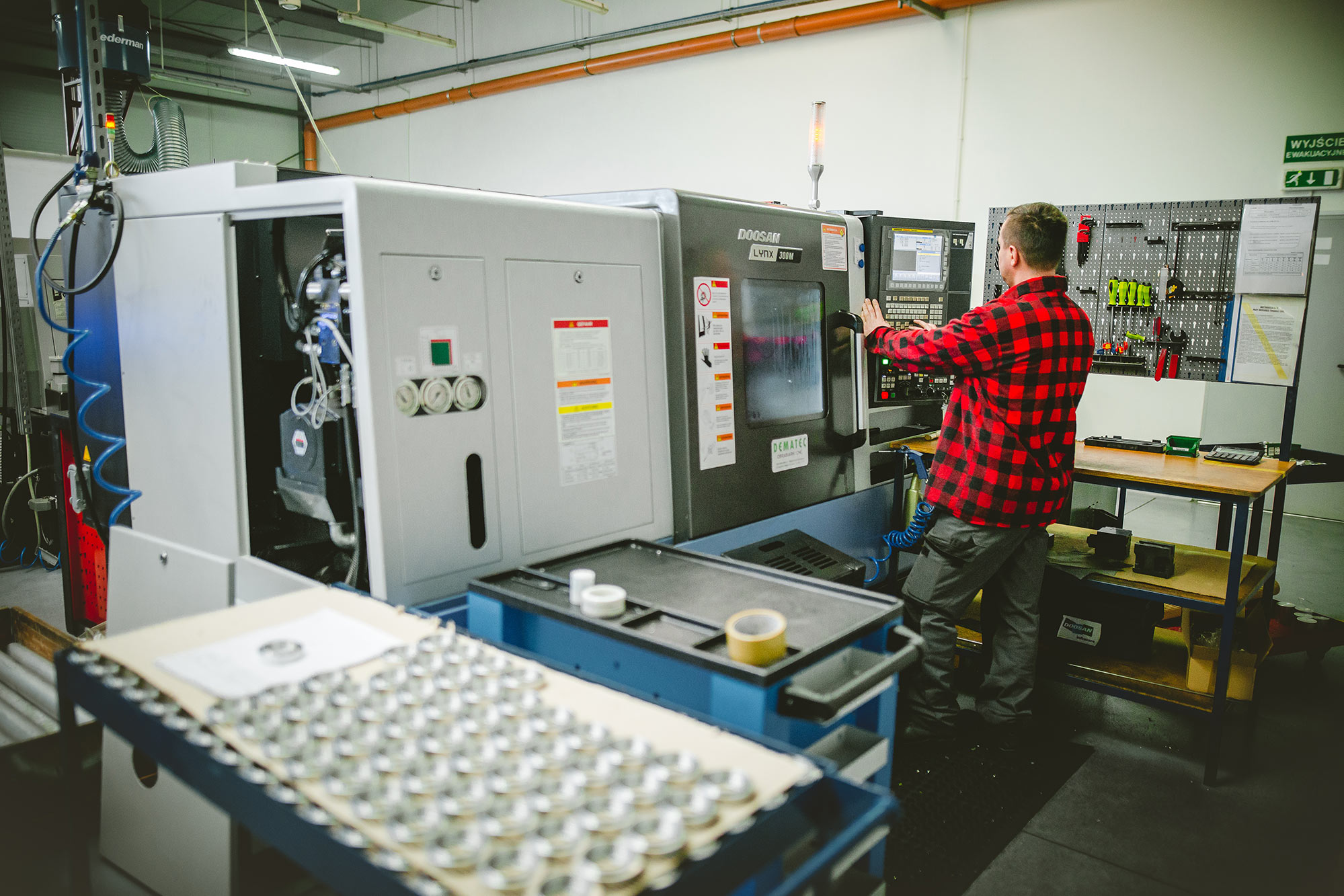
We specialise in precision CNC turning of metals and plastics for a wide range of industrial applications. We use DOOSAN lathes, DMG MORI SEIKI lathes and GILDEMEISTER lathes lathes as well as a conventional PORĘBA TURlathe. We turn to the customer’s drawing and, where one is unavailable, reproduce a part from a sample or documentation.
Numerical control makes it easier to maintain dimensional accuracy and repeatability. We turn shafts, bushes, threaded components and complex rotational parts, and agree the work scope and price from the documentation.
We work within an ISO 9001:2015 quality management system. In addition to turning, we provide CNC milling and CNC cutting – all machining in one company. We have operated since 2008.
We select the turning range according to part dimensions, geometry and material:
CNC lathes with driven tools use computer-controlled tooling systems that allow additional operations, such as hole drilling, slotting and surface milling.
We machine round, square and hexagonal stock.
The turning department includes the DOOSAN Lynx 220LMS and DOOSAN Lynx 300 M CNC lathes.
We machine, among other materials, EN AW-6082 and EN AW-7075 aluminium.
Our CNC turning services manufacture critical rotational components for the automotive industry – precision shafts, bushes and threaded connectors. We maintain the rigorous quality standards needed in automotive while providing cost-effective solutions for both prototypes and serial production.
Aerospace applications benefit from our precision turning capability for critical rotational components requiring high dimensional accuracy and surface quality. Our quality-management systems and material traceability support demanding aerospace specifications throughout production.
Machine-building sectors rely on our versatility in component sizes and materials – drive shafts, bushes and precision rollers. Our capability covers both small precision parts and large structural components.
Energy and renewable systems use our expertise in turning components operating in demanding environments – durability and precision for critical applications. Our material knowledge and quality systems support reliable performance in applications requiring long-term reliability.
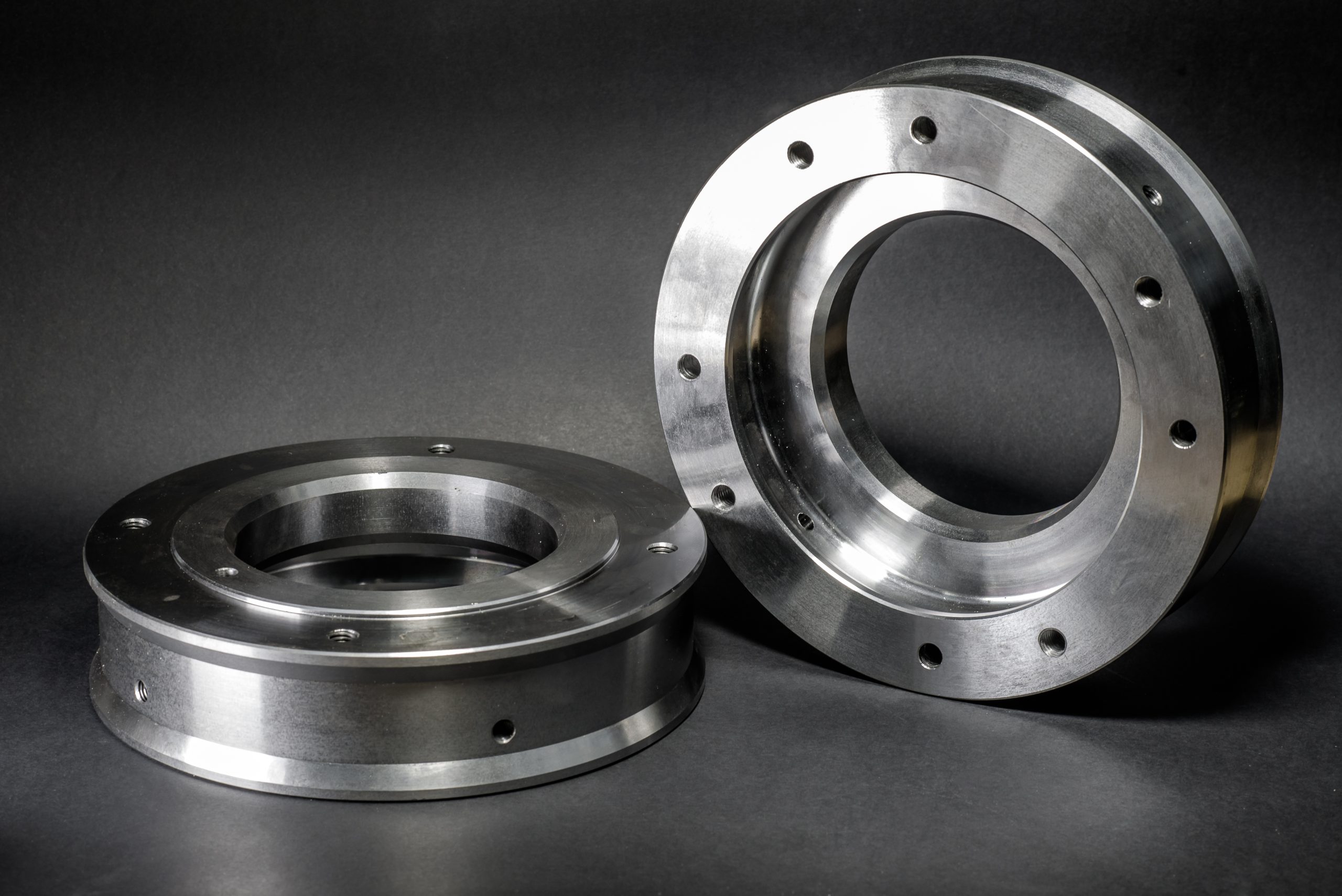
Our turning services are suited to producing shafts for mechanical systems that require precise dimensional control and surface quality. We manufacture drive shafts, bushes and rotational components with tolerances from ±0.01 mm.
The production of threaded components includes fasteners, connectors and mechanical assemblies requiring precise thread specification – the correct form, pitch and surface quality.
Production of bushes and bearing races uses our ability to maintain tight tolerances. These components require consistent bore dimensions and surface quality for correct bearing operation.
Production of tapered components – precise angular geometries and dimensional transitions for mechanical assemblies and tooling applications.
See projectsWe regularly assess new turning technologies, tooling solutions and improvements to control systems.
View the machine park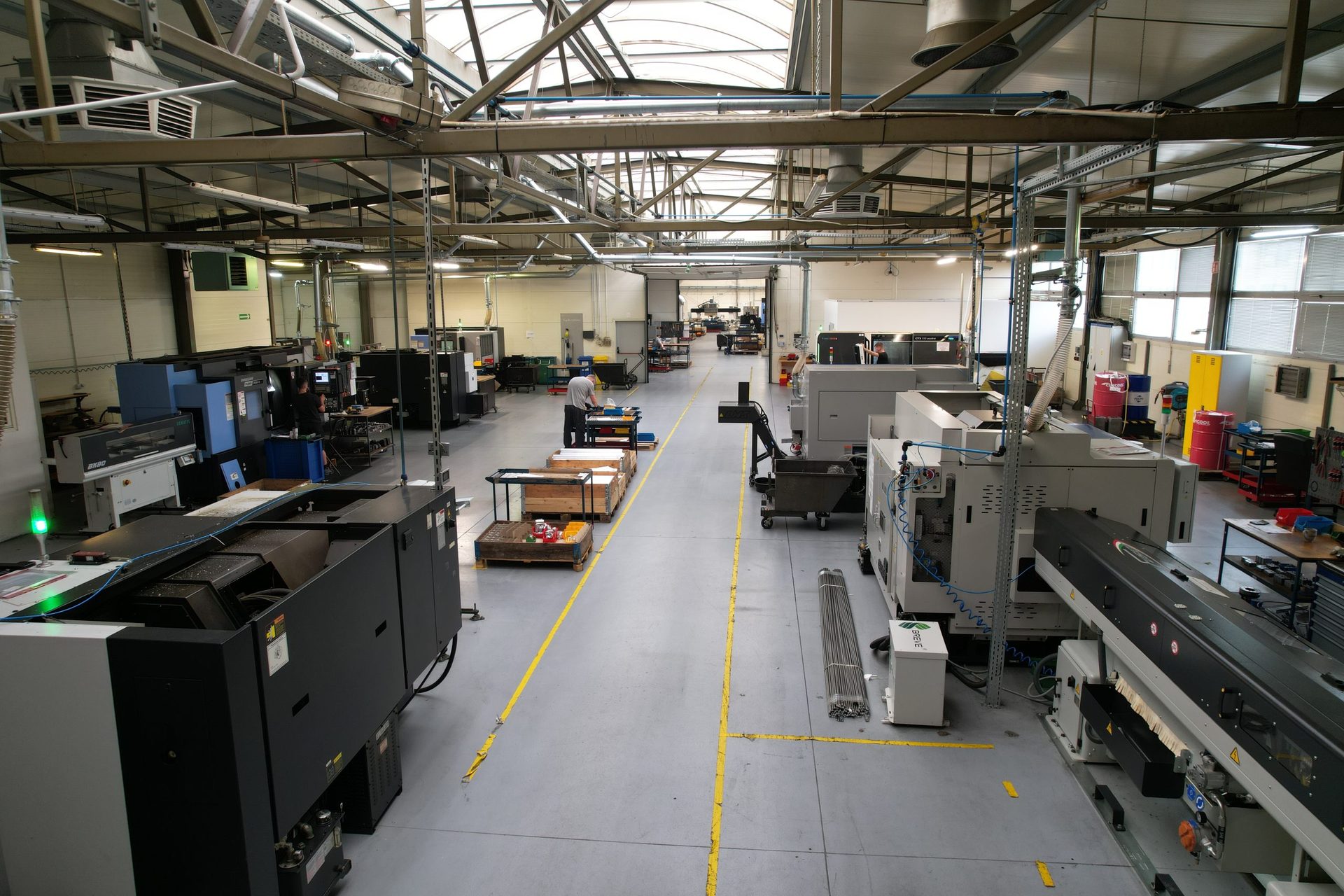
Tooling strategies include the selection of high-performance cutting tools, optimised machining parameters and specialist clamping solutions. The result is improved surface quality, greater dimensional accuracy and shorter cycle times.
Turning-process monitoring tracks tool condition and material behaviour. Process data supports parameter optimisation for new materials and demanding geometries.
Quality-system integration ensures that technology improvements comply with our ISO 9001:2015 requirements and our customers’ quality requirements.
CNC lathes (DOOSAN, DMG MORI SEIKI, GILDEMEISTER) – turning up to Ø 415 mm and length L = 1000 mm. PORĘBA TUR conventional lathe – Ø 465 mm, L = 3000 mm. TSUGAMI BO326EII – range Ø 8-32 mm, 6 axes. DMG/MORI Sprint MF65 – range Ø 10-65 mm, counter spindle and Y axis.
Materials: S235JR/S355J2 structural steels, 42CrMo4/16MnCr5/34CrNiMo6 alloy steels, 316L (1.4404) stainless steel, EN AW-6082/5083 aluminium, Cu-ETP copper, CuSn12 bronze, brass, titanium and engineering plastics (PEEK, PTFE, POM, PA-6).
After you send a DXF/STEP drawing, we will propose the material grade, machining parameters and certificate (3.1 EN 10204, PPAP for automotive). ANBI-TECH Sp. z o.o., Olewin 50A, 32-300 Olkusz. Telephone +48 32 788 70 10.
CNC turning is a machining method used primarily to make rotational parts. The workpiece is clamped in a chuck and rotates around its axis, while a turning tool removes successive layers of material. Controlled tool movement makes it possible to obtain the required diameter, length and shape.
The material being machined can be, and usually is, round, although square and hexagonal stock is also used. The length of the machined stock can vary and depends on the machine tool’s capabilities.
Each CNC lathe has its own set of computer-controlled tools. The more tools a lathe has, the more operations can be completed in one process. Some CNC machines can stop the rotation of the workpiece at any time to perform additional functions such as:
We turn precision components from a range of metals and engineering plastics. We select the machine tool according to the material, part dimensions and required tolerance.
The indicative hourly rate for CNC turning is 140-250 PLN/h.
| Service | Indicative rate |
|---|---|
| CNC turning | 140-250 PLN/h |
These are indicative ranges, not a price list for finished parts. The price depends on material, geometry, tolerance, batch size and program-preparation time. Send a technical drawing or CAD file and we will prepare an individual quotation.
Milling and CNC turning are both machining processes, but differ in how the tool and workpiece move. The process is selected primarily according to the geometry of the part being made.
CNC milling is performed using a numerically controlled milling machine. The CNC program guides the tool along a specified path, while the operator prepares the clamping, sets the datum point and supervises machining. Manual mode is used, among other things, to set axes, position the tool and make corrections. It is not a separate method of process control, because machining still takes place within the CNC system.
CNC turning differs from milling. It also relies on computer programs, but produces a somewhat different final product. In this process, the cutting tool moves parallel to the workpiece. Here, however, the material rotates at a set speed while the cutting tool moves to create cuts with precise depths and diameters. CNC turning can be used on the outside of the material to achieve a round form or inside it to create a round recess.
Metal turning is a form of machining in which unwanted material is removed from a workpiece. The process requires a lathe with a cutting tool and a workpiece. The workpiece is a piece of material fixed in the machine’s chuck and rotating at high speed. The tool is usually a single-point cutting tool mounted in the machine. It approaches the workpiece and cuts material away as chips until the desired shape is achieved.
Turning is used to produce rotational parts with features such as holes, grooves, threads, tapers and different diameter steps. It can also refine parts made in other processes, for example after CNC milling or CNC cutting.
Cutting speed and spindle speed when turning aluminium are selected according to the alloy, workpiece diameter, geometry, tool material and cooling method. Aluminium often permits higher cutting speeds than steels, but the spindle speed follows the required cutting speed and workpiece diameter, so it is not automatically set to the maximum.
When turning a long piece of aluminium, the free end may become unstable. The limit above which a workpiece needs specialist supports is a length-to-diameter ratio L/D greater than 20.
Turning copper requires appropriate selection of the tool, cutting parameters and cooling. For complex parts, copper alloys with better machinability may also be worth considering where project requirements allow.
Turning engineering plastics requires consideration of thermal expansion, stiffness and susceptibility to deformation. This applies, among other things, to bushes, seals and guides made to the tolerances specified in the documentation.
When turning polyamide , cutting parameters and clamping are selected to limit heating and workpiece deformation.
Practice shows that low-carbon steel is softer and easier to machine than alloy steel. Material hardness affects machinability, so it is a very important characteristic to consider when calculating feed rates. Stainless steel belongs to the alloy-steel group, and chromium is usually the alloying element. It forms an oxide on the surface, increasing corrosion resistance. Other alloying elements, such as nickel and carbon, are also used to produce stainless steel. Stainless steels have lower thermal conductivity than carbon steels, and austenitic grades in particular tend to work-harden during machining.
Turning external cylindrical surfaces is used, among other things, to make shafts and pins. CNC lathes can machine diameters, steps, grooves and threads in accordance with technical documentation.
CNC turning is machining in which the workpiece rotates in a lathe chuck while the cutting tool moves lengthwise and crosswise, removing material and creating the desired shape. Computer control (CNC) provides repeatability and precision even in batches of thousands of pieces.
The indicative hourly rate for CNC turning is 140-250 PLN/h. The price of a finished part depends on material, geometric complexity, tolerance, batch size and programming time. Send a technical drawing or CAD file and we will prepare an individual quotation.
Achievable tolerances depend on the material and the component’s diameter and length. We provide details in a quotation based on the technical drawing.
Stainless steel, carbon steel, aluminium, brass, copper and plastics, including polyamide. We select cutting parameters for the specific material.
CNC turning: diameter up to Ø 415 mm, length up to 1000 mm. Conventional turning: Ø465 mm × 3000 mm. TSUGAMI BO326EII: Ø8-32 mm, 6 axes. DMG/MORI Sprint MF65: Ø10-65 mm, counter spindle and Y axis. We handle round, square and hexagonal material.
We make prototypes primarily when a project is intended to lead to serial production. Typical project development includes about 5 prototypes, an initial batch of 20-50 pieces, followed by batches of 100, 500 or 1000 pieces. This describes a cooperation model, not a fixed threshold.
Turning is divided by feed direction and machining location. Longitudinal turning guides the tool parallel to the workpiece axis and creates its diameter. Facing guides the tool perpendicular to the axis and forms faces and shoulders. Internal turning, or boring, machines holes and seats. Threading, parting-off and profile turning are also used. Several of these operations can be combined in one part.
Send a drawing or model in PDF, DXF, STEP, STP, STL or DWG format through the contact form. State the material, quantity and tolerances. We will reply with a quotation and completion date.
We publish references we have received and reviews from the ANBI-TECH business profile on Google Maps. The English versions are faithful translations of the Polish originals.
I can wholeheartedly recommend Anbi-Tech as a reliable and professional partner in machining and in manufacturing parts for the pharmaceutical industry. This is the third company where I have had the pleasure of working with Anbi-Tech, and the cooperation has been of the highest standard every time.
The pharmaceutical industry is exceptionally demanding: precision, on-time delivery, material quality and a full understanding of the customer’s needs all matter. Anbi-Tech has repeatedly proved that it is very well suited to this environment. The company has manufactured change parts, spare parts, filling needles, conveyor screws, components for dispensing powders and liquids, and many other production components for us.
The quality of the parts deserves particular recognition, whether they are made from 316L and 304 stainless steel or plastics such as POM, polyurethane and polycarbonate. The components are manufactured to a very high standard, with close attention to accuracy and detail, which is crucial in our industry.
Anbi-Tech has literally ‘saved our skin’ on many occasions in emergencies where time, a rapid response and a flexible approach to the customer mattered. A major strength of the company is its modern machinery, which enables it to complete even highly demanding projects while maintaining the highest standard of workmanship.
The people are equally important: the company’s staff always show complete commitment and a willingness to cooperate and provide technical support. Their extensive experience, professionalism and collaborative approach to customers are clear to see.
In pharmaceuticals, the ‘paperwork’, meaning certificates, is also important. The certificates have never been questioned during customer or regulatory audits, for example by GIF.
I strongly recommend working with Anbi-Tech to any company looking for a proven, reliable and quality-focused technical partner.
Dariusz Stachowicz, Senior Maintenance Manager, Polfa Warszawa S.A.
We had a very good experience working with Anbi-Tech on a new production line project for a bottling plant. Using a bottle sample and components from the old line, its engineer prepared the design and documentation for new change parts in SolidWorks. Anbi-Tech then manufactured timing screws, star wheels, drive components, bottle orienters, bottle turners and feeding components, among other items.
A major advantage is the end-to-end approach, from analysis and design through to the manufacture of finished components. Their considerable technical experience, precision and ability to solve unusual problems are clear. I recommend them.
Bartłomiej Ć, Specialist, ORLEN
We work with Anbi-Tech to manufacture parts and technical components for our projects. We value them above all for their workmanship, on-time delivery and excellent communication. When requirements are unusual, they can advise us and find a solution instead of simply manufacturing a part from a drawing. A reliable partner that I am happy to recommend.
Marek P., Production Manager, Triccor
A reliable company with extensive experience! They manufacture parts from steel, aluminium and specialist plastics such as POM and PTFE. Every service, whether turning, milling or CNC cutting, is carried out perfectly and with attention to the smallest detail. Excellent communication, professional advice and consistently on-time delivery. I wholeheartedly recommend them to anyone who needs reliable components.
Damian Lab
For a quotation, send a PDF or DXF drawing or a STEP model with dimensions. State the material, the number of pieces and the quality requirements. A photograph of the part alone, without dimensions, does not allow a reliable quotation to be prepared.
If the project combines several operations, we will agree the scope of machining, inspection, assembly and processes carried out by partners.

Tel.: +48 32 788 70 10
Mobile: +48 693 726 777
Mobile: +48 693 726 127

Olewin 50A, 32-300 Olkusz
VAT ID: PL6372190715

anbi@anbi-tech.pl